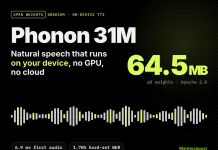
Neuphonic has released NeuTTS Air, an open-source text-to-speech (TTS) speech language model designed to run locally in real time on CPUs. The Hugging Face model card lists 748M parameters (Qwen2 architecture) and ships in GGUF quantizations (Q4/Q8), enabling inference through llama.cpp/llama-cpp-python without cloud dependencies. It is licensed under Apache-2.0 and includes a runnable demo and examples.
So, what is new?
NeuTTS Air couples a 0.5B-class Qwen backbone with Neuphonic’s NeuCodec audio codec. Neuphonic positions the system as a “super-realistic, on-device” TTS LM that clones a voice from ~3 seconds of reference audio and synthesizes speech in that style, targeting voice agents and privacy-sensitive applications. The model card and repository explicitly emphasize real-time CPU generation and small-footprint deployment.
Key Features
- Realism at sub-1B scale: Human-like prosody and timbre preservation for a ~0.7B (Qwen2-class) text-to-speech LM.
- On-device deployment: Distributed in GGUF (Q4/Q8) with CPU-first paths; suitable for laptops, phones, and Raspberry Pi-class boards.
- Instant speaker cloning: Style transfer from ~3 seconds of reference audio (reference WAV + transcript).
- Compact LM+codec stack: Qwen 0.5B backbone paired with NeuCodec (0.8 kbps / 24 kHz) to balance latency, footprint, and output quality.
Explain the model architecture and runtime path?
- Backbone: Qwen 0.5B used as a lightweight LM to condition speech generation; the hosted artifact is reported as 748M params under the qwen2 architecture on Hugging Face.
- Codec: NeuCodec provides low-bitrate acoustic tokenization/decoding; it targets 0.8 kbps with 24 kHz output, enabling compact representations for efficient on-device use.
- Quantization & format: Prebuilt GGUF backbones (Q4/Q8) are available; the repo includes instructions for
llama-cpp-pythonand an optional ONNX decoder path. - Dependencies: Uses
espeakfor phonemization; examples and a Jupyter notebook are provided for end-to-end synthesis.
On-device performance focus
NeuTTS Air showcases ‘real-time generation on mid-range devices‘ and offers CPU-first defaults; GGUF quantization is intended for laptops and single-board computers. While no fps/RTF numbers are published on the card, the distribution targets local inference without a GPU and demonstrates a working flow through the provided examples and Space.
Voice cloning workflow
NeuTTS Air requires (1) a reference WAV and (2) the transcript text for that reference. It encodes the reference to style tokens and then synthesizes arbitrary text in the reference speaker’s timbre. The Neuphonic team recommends 3–15 s clean, mono audio and provides pre-encoded samples.
Privacy, responsibility, and watermarking
Neuphonic frames the model for on-device privacy (no audio/text leaves the machine without user’s approval) and notes that all generated audio includes a Perth (Perceptual Threshold) watermarker to support responsible use and provenance.
How it compares?
Open, local TTS systems exist (e.g., GGUF-based pipelines), but NeuTTS Air is notable for packaging a small LM + neural codec with instant cloning, CPU-first quantizations, and watermarking under a permissive license. The “world’s first super-realistic, on-device speech LM” phrasing is the vendor’s claim; the verifiable facts are the size, formats, cloning procedure, license, and provided runtimes.
Our Comments
The focus is on system trade-offs: a ~0.7B Qwen-class backbone with GGUF quantization paired with NeuCodec at 0.8 kbps/24 kHz is a pragmatic recipe for real-time, CPU-only TTS that preserves timbre using ~3–15 s style references while keeping latency and memory predictable. The Apache-2.0 licensing and built-in watermarking are deployment-friendly, but publishing RTF/latency on commodity CPUs and cloning-quality vs. reference-length curves would enable rigorous benchmarking against existing local pipelines. Operationally, an offline path with minimal dependencies (eSpeak, llama.cpp/ONNX) lowers privacy/compliance risk for edge agents without sacrificing intelligibility.
Check out the Model Card on Hugging Face and GitHub Page. Feel free to check out our GitHub Page for Tutorials, Codes and Notebooks. Also, feel free to follow us on Twitter and don’t forget to join our 100k+ ML SubReddit and Subscribe to our Newsletter. Wait! are you on telegram? now you can join us on telegram as well.

Michal Sutter is a data science professional with a Master of Science in Data Science from the University of Padova. With a solid foundation in statistical analysis, machine learning, and data engineering, Michal excels at transforming complex datasets into actionable insights.