OpenAI has just released GPT-5-Codex, a version of GPT-5 further optimized for “agentic coding” tasks within the Codex ecosystem. The goal: improve reliability, speed, and autonomous behavior so that Codex acts more like a teammate, not just a prompt-executor.
Codex is now available across the full developer workflow: CLI, IDE extensions, web, mobile, GitHub code reviews. It integrates well with cloud environments and developer tools.
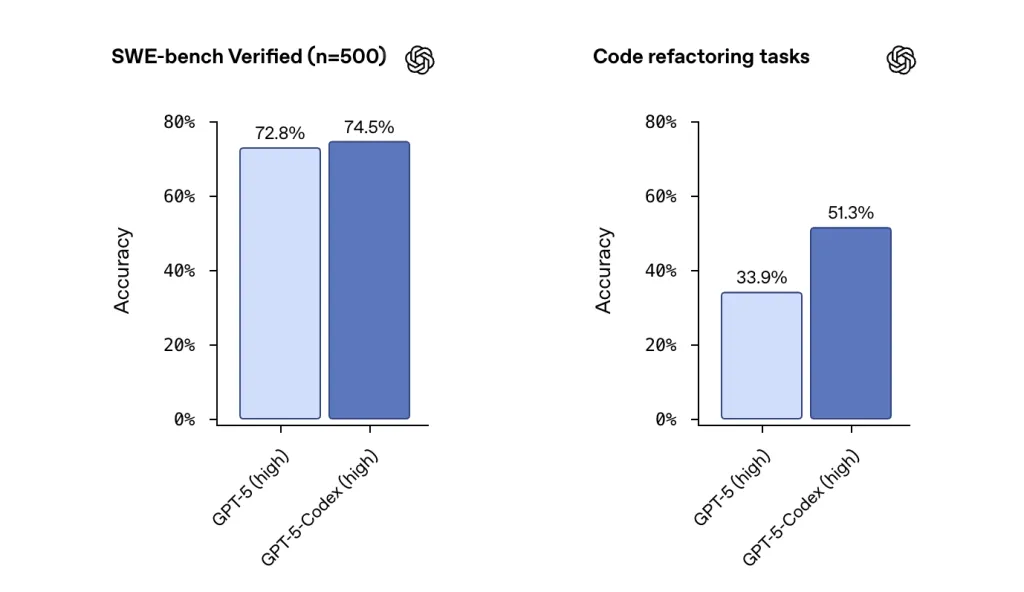
Key Capabilities / Improvements
- Agentic behavior
GPT-5-Codex can take on long, complex, multi-step tasks more autonomously. It balances “interactive” sessions (short feedback loops) with “independent execution” (long refactors, tests, etc.). - Steerability & style compliance
Less need for developers to micro-specify style / hygiene. The model better understands high-level instructions (“do this”, “follow cleanliness guidelines”) without being told every detail each time. - Code review improvements
- Trained to catch critical bugs, not just surface or stylistic issues.
- It examines the full context: codebase, dependencies, tests.
- Can run code & tests to validate behavior.
- Evaluated on pull requests / commits from popular open source. Feedback from actual engineers confirms fewer “incorrect/unimportant” comments.
- Performance & efficiency
- For small requests, the model is “snappier”.
- For big tasks, it “thinks more”—spends more compute/time reasoning, editing, iterating.
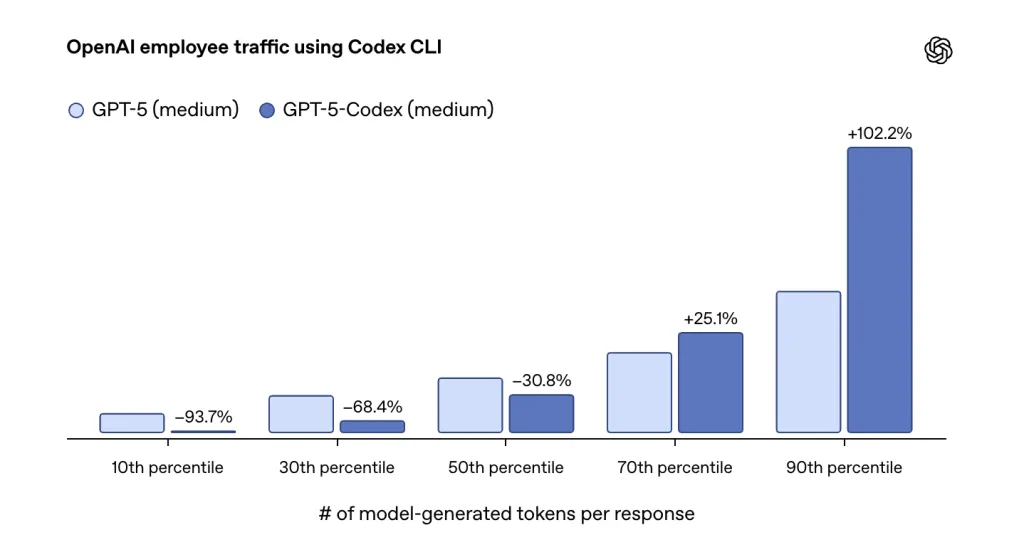
- On internal testing: bottom-10% of user turns (by tokens) use ~93.7% fewer tokens than vanilla GPT-5. Top-10% use roughly twice as much reasoning/iteration.
- Tooling & integration improvements
- Codex CLI: better tracking of progress (to-do lists), ability to embed/share images (wireframes, screenshots), upgraded terminal UI, improved permission modes.
- IDE Extension: works in VSCode, Cursor (and forks); maintains context of open files / selection; allows switching between cloud/local work seamlessly; preview local code changes directly.
- Cloud environment enhancements:
- Cached containers → median completion time for new tasks / follow-ups ↓ ~90%.
- Automatic setup of environments (scanning for setup scripts, installing dependencies).
- Configurable network access and ability to run pip installs etc. at runtime.
- Visual & front-end context
The model now accepts image or screenshot inputs (e.g. UI designs or bugs) and can show visual output, e.g. screenshots of its work. Better human preference performance in mobile web / front-end tasks. - Safety, trust, and deployment controls
- Default sandboxed execution (network access disabled unless explicitly permitted).
- Approval modes in tools: read-only vs auto access vs full access.
- Support for reviewing agent work, terminal logs, test results.
- Marked as “High capability” in Biological / Chemical domains; extra safeguards.
Use Cases & Scenarios
- Large scale refactoring: changing architecture, propagating context (e.g. threading a variable through many modules) in multiple languages (Python, Go, OCaml) as demonstrated.
- Feature additions with tests: generate new functionality and tests, fixing broken tests, handling test failures.
- Continuous code reviews: PR review suggestions, catching regressions or security flaws earlier.
- Front-end / UI design workflows: prototype or debug UI from specs/screenshots.
- Hybrid workflows human + agent: human gives high-level instruction; Codex manages sub-tasks, dependencies, iteration.
Implications
- For engineering teams: can shift more burden to Codex for repetitive / structurally heavy work (refactoring, test scaffolding), freeing human time for architectural decisions, design, etc.
- For codebases: maintaining consistency in style, dependencies, test coverage could be easier since Codex consistently applies patterns.
- For hiring / workflow: teams may need to adjust roles: reviewer focus may shift from “spotting minor errors” to oversight of agent suggestions.
- Tool ecosystem: tighter IDE integrations mean workflows become more seamless; code reviews via bots may become more common & expected.
- Risk management: organizations will need policy & audit controls for agentic code tasks, esp. for production-critical or high-security code.
Comparison: GPT-5 vs GPT-5-Codex
| Dimension | GPT-5 (base) | GPT-5-Codex |
|---|---|---|
| Autonomy on long tasks | Less, more interactive / prompt heavy | More: longer independent execution, iterative work |
| Use in agentic coding environments | Possible, but not optimized | Purpose-built and tuned for Codex workflows only |
| Steerability & instruction compliance | Requires more detailed directions | Better adherence to high-level style / code quality instructions |
| Efficiency (token usage, latency) | More tokens and passes; slower on big tasks | More efficient on small tasks; spends extra reasoning only when needed |
Conclusion
GPT-5-Codex represents a meaningful step forward in AI-assisted software engineering. By optimizing for long tasks, autonomous work, and integrating deeply into developer workflows (CLI, IDE, cloud, code review), it offers tangible improvements in speed, quality, and efficiency. But it does not eliminate the need for expert oversight; safe usage requires policies, review loops, and understanding of the system’s limitations.
Check out the FULL TECHNICAL DETAILS here. Feel free to check out our GitHub Page for Tutorials, Codes and Notebooks. Also, feel free to follow us on Twitter and don’t forget to join our 100k+ ML SubReddit and Subscribe to our Newsletter.

Michal Sutter is a data science professional with a Master of Science in Data Science from the University of Padova. With a solid foundation in statistical analysis, machine learning, and data engineering, Michal excels at transforming complex datasets into actionable insights.