Estimated reading time: 6 minutes
Table of contents
Introduction
A proxy server is a vital intermediary between clients and destination servers, facilitating both security and speed in the modern internet. In 2025, with digital privacy, enterprise security, and data-driven automation to the forefront, proxy servers are indispensable for individuals and organizations. The global web proxy market is projected to reach $50 billion by 2026, propelled by ongoing privacy and compliance demands.
What Is a Proxy Server?
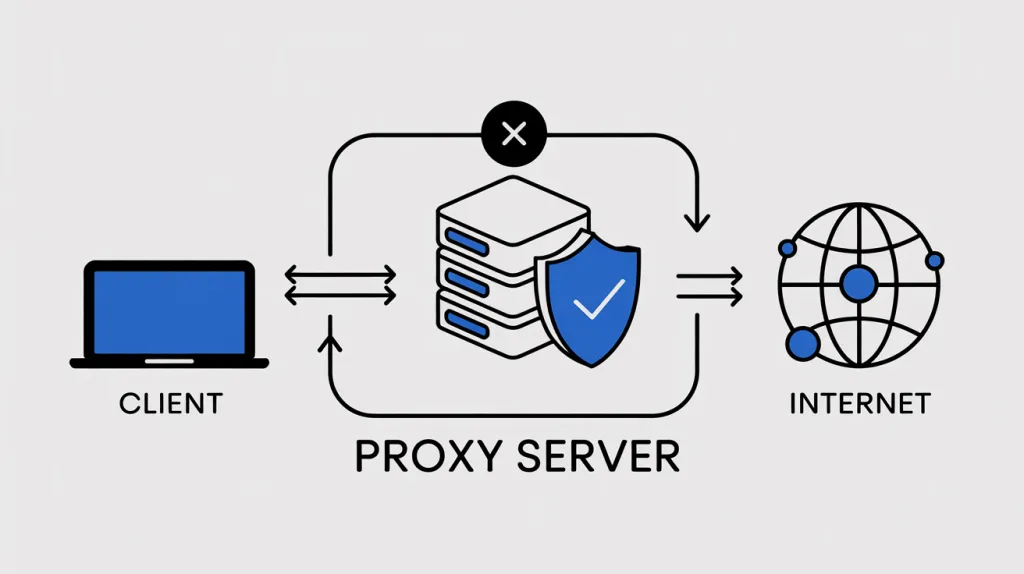
A proxy server is a dedicated system or software relay that takes requests from a client (e.g., a browser) and forwards them to a target server. The proxy then collects the server’s response and returns it to the client. This arrangement can filter, cache, monitor, and secure traffic flows.
Technical Architecture:
Key Functions (2025):
- Request/response interception and filtering
- Protocol translation (HTTP, HTTPS, SOCKS5)
- Web content caching for speed
- Traffic monitoring and logging
- IP address masking for privacy
- Encrypted connections (TLS 1.3, Encrypted SNI)
Types of Proxy Servers
| Proxy Type | Hides IP | Reveals Proxy | Client Config | Common Use Case |
|---|---|---|---|---|
| Forward | Yes | Yes | Required | Anonymous browsing, filtering |
| Reverse | No | No | Server-side | Load balancing, WAF, DDoS defense |
| Transparent | No | No | Not needed | Caching, monitoring |
| Anonymous | Yes | Yes | Required | Geo content access, basic privacy |
| Elite (High-Anon) | Yes | No | Required | Secure scraping, maximum privacy |
Descriptions:
- Forward Proxy: Works on behalf of the client, enabling privacy, content filtering, and access control.
- Reverse Proxy: Handles traffic before it reaches backend servers, enabling load balancing, web security, and SSL termination.
- Transparent Proxy: Operates without client knowledge, mainly for caching and policy enforcement by ISPs or organizations.
- Anonymous Proxy: Hides real IP address but reveals presence of a proxy, useful for regional content access.
- High-Anonymity Proxy: Masks both IP and proxy use, crucial for advanced privacy and large-scale automation.
Key Use Cases in 2025
- Online Privacy & Anonymity: Essential for journalists, activists, and privacy seekers.
- Content Filtering: Enterprises block malicious or unwanted websites.
- Network Security & Firewalls: Reverse proxies enforce security, inspect traffic, and shield against attacks.
- Load Balancing & Scalability: Distributes traffic for uptime and performance.
- Web Caching: Speeds up delivery of popular content and reduces server load.
- AI Automation & Scraping: Proxies enable distributed, stealthy data collection for business intelligence.
Emerging Trends in Proxy Servers (2025)
- AI-Driven Traffic Analysis: Proxies now integrate machine learning for anomaly detection and route optimization.
- Edge Proxy Servers: Positioned near users for lower latency, vital for CDNs and IoT.
- Zero Trust Security: Proxies act as policy enforcers at every network access point.
- Encrypted Communication: TLS 1.3 and Encrypted SNI protect proxy traffic from surveillance.
- Performance Optimization: Advanced connection pooling and protocol upgrades (HTTP/2, SOCKS5) deliver up to 80% latency improvements.
Top Proxy Server Providers in 2025
The following companies lead the market with robust feature sets, massive global coverage, high reliability, and strong user feedback:
| Provider | IP Pool Size / Coverage | Proxy Types | Key Strengths / Notes | Starting Price |
|---|---|---|---|---|
| Oxylabs* | 177M+ IPs, 195+ countries | Residential, Datacenter, ISP, Mobile, Web Unblocker | 99.95% success rate, free geo-targeting, top rated 24/7 customer support | $4/GB residential, $12/mo datacenter (5 free IPs for testing) |
| Decodo(Smartproxy)* | 125M+ IPs, 195+ countries | Residential, ISP, Datacenter, Mobile, Site Unblocker | 99.99% uptime, #1 response time in the market, advanced geo-targeting, 24/7 tech support, extensive documentation | 3-day free trial available, $1.5/GB residential, $0.27/IP ISP, $4.5/GB mobile, $0.026/IP datacenter, $1.6/1K req Site Unblocker |
| Webshare* | 80M+ IPs, 195+ countries | Datacenter, Static Residential (ISP), Rotating Residential, YouTube Proxies | Developer-focused, affordable, easy setup | $2.99/mo datacenter, free plan (10 DC proxies & 1GB/mo bandwidth) |
| Bright Data | 150M+ residential IPs, 195+ countries | Residential, Datacenter, ISP, Mobile | Largest pool, precise geo-targeting, strong compliance | $2.94/GB residential |
| SOAX | 191M+ IPs, global reach | Residential, Mobile, ISP | Low-latency, ethical sourcing, premium SOCKS5 support | $4/GB, $90/port/mo |
| IPRoyal | 32M+ IPs, 195+ countries | Residential, Datacenter, ISP, Mobile | Rotating/sticky IPs, budget-friendly, SOCKS5 support | $2.45/GB residential |
| Rayobyte | 300K datacenter, 40M+ residential | Datacenter, Residential, ISP, Mobile | US coverage, transparent geo-targeting | $3.50/GB residential, datacenter varies |
Provider Notes:
- Leading providers: Oxylabs and Bright Data set industry benchmarks for reliability and sheer IP numbers.
- Budget options: Decodo (Smartproxy), IPRoyal, and Webshare offer affordable plans and flexible trials.
- Premium features: SOAX provides ethical pools, low latency, and advanced protocol support.
- User experience: Most vendors offer free trial periods and expert support in multiple languages.
Choosing a Provider:
Consider IP pool size, coverage, protocol support (HTTP/HTTPS/SOCKS5), platform tools, customer support, compliance, and pricing structure.
Conclusion
In 2025, proxy servers are fundamental to secure, private, and optimized internet usage—from web privacy to network defense and scalable automation. New advances in AI, encryption, and edge networks are transforming proxy technology into smarter, faster, and more resilient tools.
Selecting the right proxy type and provider is crucial for architects, sys-admins, businesses, and individuals seeking robust connectivity and compliance amid evolving digital challenges.
FAQ: Frequently Asked Questions about Proxy Servers
- What is a proxy server used for? A proxy server is used for anonymizing internet traffic, content filtering, web caching, improving security, and balancing network loads.
- How does a proxy server improve privacy? It hides the user’s real IP address by forwarding requests through an intermediary server, thus masking identity from destination sites.
- What’s the difference between a forward and reverse proxy? A forward proxy sits in front of the client and filters outbound requests, while a reverse proxy sits in front of the server and manages inbound traffic.
- Are proxy servers legal? Yes, using a proxy server is legal in most countries. However, using proxies for illegal activities (e.g., fraud, hacking) is not.
- What is the safest type of proxy server? High-anonymity or elite proxies offer the most privacy and are typically considered the safest for sensitive use cases.
- Can I set up my own proxy server? Yes, you can set up your own proxy using tools like Squid, HAProxy, or Nginx, either on a local machine or cloud instance.
TL;DR
- Proxy servers are now vital for privacy, enterprise security, and automation, with the global market projected to reach $50 billion by 2026.
- A proxy server acts as an intermediary between clients and servers, enabling traffic filtering, IP masking, caching, monitoring, and encryption.
- Types of proxies: forward, reverse, transparent, anonymous, and high-anonymity, each serving distinct privacy, security, and performance roles.
- Common use cases in 2025: privacy protection, content filtering, network defense, load balancing, caching, and AI-driven web scraping.
- Technical advances: proxies use AI for traffic analysis, edge deployment for lower latency, zero-trust access enforcement, encrypted connections, and protocol upgrades for performance.
- Leading providers: Oxylabs, Bright Data, Decodo (Smartproxy), SOAX, Webshare, IPRoyal, and Rayobyte—each offering unique features, pricing, IP pool sizes, and support.
- High-anonymity proxies (elite) are considered safest for sensitive activity, offering advanced privacy by masking both IP and proxy use.
- Setting up a proxy is possible using software like Squid, HAProxy, or Nginx, locally or in the cloud.
- Choosing a provider requires considering IP pool size, global coverage, protocol support (HTTP/HTTPS/SOCKS5), customer service, compliance, and price structure.
- Proxy technology in 2025 is driven by new demands for security, compliance, and automation, with AI and encryption making it smarter and faster than ever.
*Affiliate/paid

Michal Sutter is a data science professional with a Master of Science in Data Science from the University of Padova. With a solid foundation in statistical analysis, machine learning, and data engineering, Michal excels at transforming complex datasets into actionable insights.