Cancer therapy has long been a field of intense research and clinical practice, seeking innovative treatments to improve patient outcomes. This complex domain requires continuous exploration beyond conventional methods, particularly as patients and healthcare providers often face the challenge of limited treatment options. The quest for effective cancer management is a multidisciplinary effort that combines the latest in medical research with practical clinical strategies to address the diverse needs of patients across various cancer types.
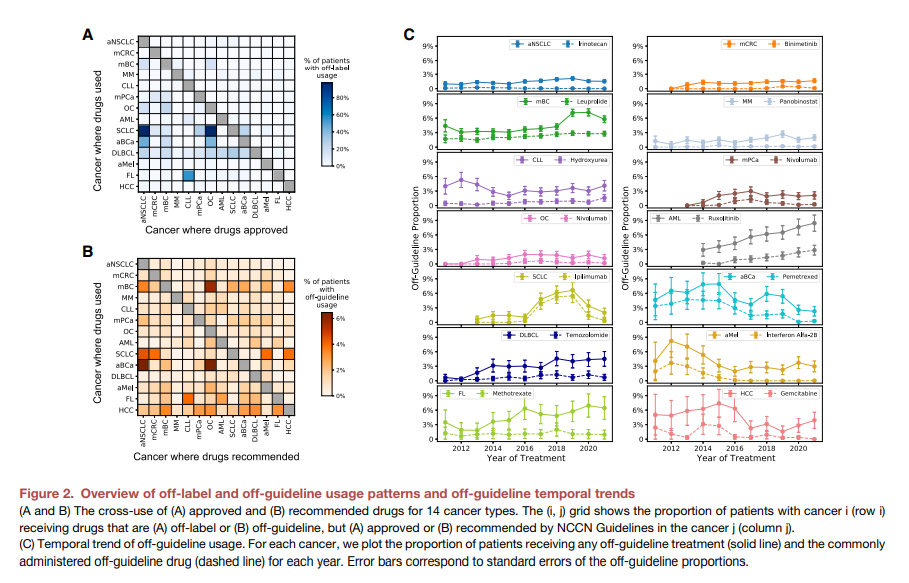
A prevalent issue in cancer care is the use of treatments not officially approved or recommended by standard guidelines, known as off-label and off-guideline usage. This approach has been a pivotal part of oncology, offering alternative treatment pathways for patients without other options. The flexibility in treatment choices reflects the dynamic nature of cancer therapy, where innovations and patient-specific considerations drive clinical decisions.
Current practices in cancer treatment frequently involve off-label drug use, which is prescribed in ways that are not officially sanctioned by regulatory bodies. This includes using drugs for cancer types or stages not explicitly approved or for patient groups not included in original clinical trials. Such practices need scrutiny, as they raise questions about efficacy, safety, and the ethical implications of using treatments without formal endorsement.
A groundbreaking study by a research team from Stanford University, Genentech, and the University of Southern California introduced a novel method to analyze off-label and off-guideline cancer therapy usage. Leveraging a data science framework, the study systematically characterizes the patterns of unconventional drug use across 14 common cancer types, drawing from a real-world cohort of 165,912 patients in the United States.
The proposed framework delves deeper into the methodology, employing advanced machine learning models to predict which patients are more likely to receive off-label and off-guideline treatments based on their clinical characteristics and treatment history. This innovative approach sheds light on current treatment patterns and identifies potential areas for future research and clinical practice improvement.
A key finding of the study is the significant prevalence of off-label and off-guideline drug usage among cancer patients, with 18.6% and 4.4% of the cohort receiving such treatments, respectively. The analysis revealed that patients with worse performance status, undergoing later lines of therapy, or being treated at academic hospitals were to receive these unconventional treatments. The study quantified the adoption patterns of immunotherapies, highlighting the evolving landscape of cancer treatment.
This research contributes to the complex dynamics of cancer therapy, underscoring the need for a nuanced understanding of off-label and off-guideline drug usage. By systematically analyzing real-world data, the study offers a foundation for further exploration of alternative treatment strategies, potentially leading to more personalized and effective cancer care.
In conclusion, exploring off-label and off-guideline cancer therapy usage is vital for enhancing patient outcomes in oncology. The study’s comprehensive approach and findings underscore the importance of flexibility in treatment planning, the potential of machine learning in predicting treatment pathways, and the ongoing need for rigorous analysis to inform clinical decision-making.
Check out the Paper. All credit for this research goes to the researchers of this project. Also, don’t forget to follow us on Twitter and Google News. Join our 38k+ ML SubReddit, 41k+ Facebook Community, Discord Channel, and LinkedIn Group.
If you like our work, you will love our newsletter..
Don’t Forget to join our Telegram Channel
You may also like our FREE AI Courses….
Sana Hassan, a consulting intern at Marktechpost and dual-degree student at IIT Madras, is passionate about applying technology and AI to address real-world challenges. With a keen interest in solving practical problems, he brings a fresh perspective to the intersection of AI and real-life solutions.