
Harness
Breaking News
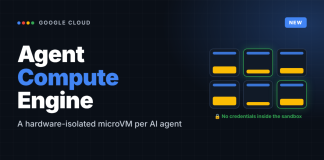
Google Cloud Launches Agent Compute Engine: A MicroVM per AI Agent
Google Cloud announced Agent Compute Engine, a compute service that gives every AI agent its own hardware-isolated microVM with no credentials inside. It already runs Gemini agents and enters preview in the coming months.
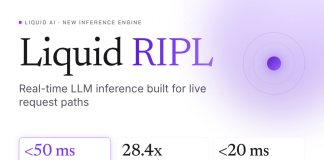
Liquid AI Launches RIPL, a Real-Time Inference Engine for Sub-50 ms...
Liquid AI released RIPL, a real-time inference engine for its LFM models. On one B200, LFM2.5-1.2B on RIPL showed 14.4 to 28.4x lower p95 latency than Qwen3.5-0.8B on vLLM.
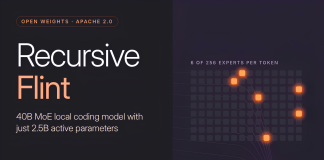
Recursive Releases Flint, an Open-Weight 40B MoE Local Coding Model for...
Recursive has released Flint, an Apache 2.0 local coding model with 40B total and 2.5B active parameters. It reports 74.2% on SWE-bench Verified and 125+ tokens per second on an M4 Pro MacBook Pro.
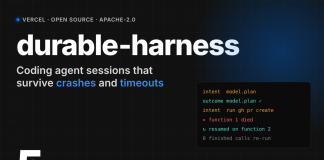
Vercel Open-Sources durable-harness for Crash-Proof Coding Agents
Vercel released durable-harness, an open-source package that logs every model and tool call so Pi, OpenCode, Claude Code and Codex sessions resume after crashes, timeouts and redeploys on Vercel, Postgres or a laptop.
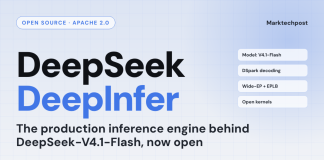
DeepSeek Open-Sources DeepInfer, the Inference Framework Behind DeepSeek-V4.1-Flash
DeepSeek has open-sourced DeepInfer, the Apache 2.0 inference framework that serves DeepSeek-V4.1-Flash in production. It targets NVIDIA SM100 GPUs and Huawei Ascend 950 NPUs, and ships offline inference only.
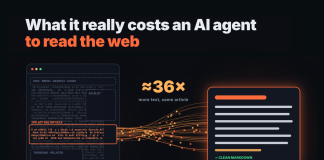
TinyFish Makes Search Free: What It Really Costs an AI Agent...
An AI agent that reads the web pays 2 kinds of cost. The first is the retrieval charge: what a search or fetch API...
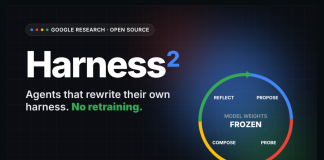
Google Open-Sources Harness2, a Recursive Agent Harnessing Framework
Google Research released Harness2, an Apache-2.0 framework that rewrites an agent's harness at test time. One refinement step lifted GLM-5 by 11.5 points on WorkBuddy-Bench with no weight updates.
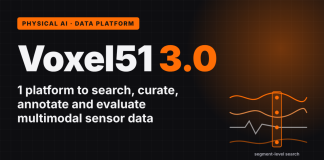
Meet Voxel51 3.0: A Unified Multimodal Data Platform for Physical AI
Voxel51 3.0 merges search, curation, annotation and evaluation of multimodal sensor data into one platform for physical AI teams. It adds Voxel51 Agent with 45+ MCP tools, dataset versioning, and a free self-service tier.
Meet Kyutai REKI: The 2.4B VLA Model Bringing Efficient Memory to...
Kyutai, with Inria and École des Ponts, has released REKI, a 2.4B vision-language-action model (VLA) for robot manipulation. The REKI vision-language-action model is pretrained...
Nace AI Open-Sources Drex 1.5: A 9B Decision Model That Scores...
Nace.AI has open-sourced Drex 1.5, a 9B decision model that returns a probability for every option in 1 forward pass. It scores 58.08 on Decision Index 0.3.1 and reads up to 128K tokens.

What Happens When a Trusted Model Repo Changes? Unsloth Studio Re-Checks...
Unsloth's October 6 security overview explains how Studio checks code, weights, packages and tools before anything runs. Custom model code is scanned and approval is bound to its fingerprint. Flagged weight files are blocked in the load path, package-content findings fail CI, and tools run in probed OS sandboxes. Here is what each checkpoint decides, and what it does not cover.
Anthropic Releases Claude Haiku 5.5: A Small Model With 1M Context...
Anthropic's Claude Haiku 5.5 starts at $0.10 per million input tokens, keeps 1M context, scores 72.4% on OSWorld.
Reflection AI Introduces Beam: A 501B Open-Weight MoE Model With 23B...
Reflection AI has introduced Beam, its first open-weight model. It is a 501B sparse Mixture-of-Experts model with 23B active parameters, built for coding and agentic work. Reflection says it matches GLM-5.2 on reasoning with 3 to 4x less inference compute. Apache 2.0 weights are due later in October 2026.
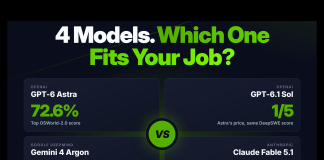
GPT-6 Astra vs GPT-6.1 Sol vs Gemini 4 Argon vs Claude...
Astra leads computer use, Argon leads legal and finance work, and Sol wins on price for coding agents.

Cloudflare Releases Clef and Clef-flash: Open-Weight Decision Models That Return Typed...
Cloudflare has released Clef (27B) and Clef-flash (9B), open-weight decision models that return typed probabilities instead of text. They are Jev-API compatible, accept images, and run on Workers AI at 209.3 ms and 38.8 ms median latency.

Google DeepMind Unveils Gemini 4 Argon with 1M Output Tokens for...
Gemini 4 Argon tops GPT-6 Astra and Claude Opus 5.5 on most benchmarks, but access remains gated today.
One Bad Prompt Took Down a Company’s Salesforce: RSA’s Jim Taylor...
RSA launched Agent ID at The AI Conference in San Francisco. It's an agentic identity security platform for finance, government, healthcare, and critical infrastructure. It has 3 modules. Discover finds sanctioned and shadow agents and MCP servers. Secure is an inline gateway that checks every tool call against policy. Govern maps evidence to 10 regulatory frameworks. Discover and Secure ship November 16, 2026.
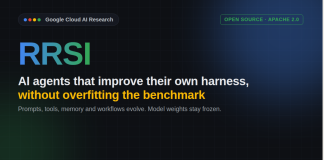
Google Research Open-Sources RRSI: AI Agents That Improve Their Own Harness...
Google Cloud AI Research has open-sourced RRSI, a framework that lets LLM agents rewrite their own prompts, tools and memory while model weights stay frozen. It adds a leakage critic, a noise floor, a cost rule and pruning so gains carry over to new tasks. With Claude Opus 4.8, Terminal-Bench 2.1 rose from 74.2% to 80.2%, and all 6 held-out splits improved.
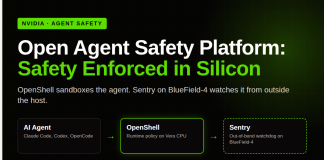
NVIDIA Launches Open Agent Safety Platform: OpenShell Sandboxes Agents on Vera...
NVIDIA has launched the Open Agent Safety Platform, an open reference design that enforces AI agent safety outside the agent itself. OpenShell, an Apache 2.0 runtime, sandboxes agents under YAML policies. Sentry, an out-of-band watchdog on BlueField-4 DPUs, can quarantine an agent that escapes its boundary in milliseconds. NVIDIA says over 100 organizations are working with the platform.
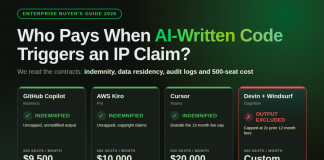
AI Coding Agents for Enterprise: IP Indemnity, Data Residency and 500-Seat...
We read the contracts behind GitHub Copilot, AWS Kiro, Cursor, Devin and Windsurf. Copilot and Kiro offer uncapped indemnity on generated code. Cognition's standard terms exclude outputs entirely. Here is how 500 seats compare on legal exposure, prompt storage, audit logs and true cost.
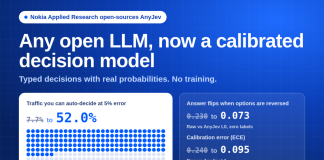
Nokia Open-Sources AnyJev: A Training-Free Layer That Turns Any Open LLM...
Nokia's applied research team has open-sourced AnyJev, a Python library that turns an open LLM into a decision model. It needs no training. It...
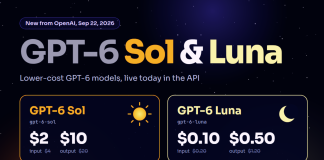
OpenAI Releases GPT-6 Sol and Luna: 50% Cheaper API Pricing and...
OpenAI has released GPT-6 Sol and GPT-6 Luna, 2 lower-cost models trained with methods similar to GPT-6 Astra. Sol costs $2/$10 and Luna $0.10/$0.50 per 1M tokens. Both are available now in the API, ChatGPT Work and Codex. They come with improved prompt caching for long-running agents.
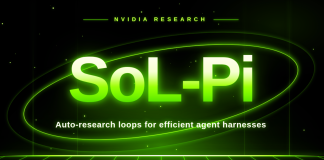
NVIDIA Introduces SoL-Pi: Auto-Research Loops That Cut Coding Agent Token Traffic...
NVIDIA researchers have released SoL-Pi, 4 harness mechanisms for the open-source Pi coding agent, discovered by an AI running auto-research loops across 535 environments. On EdgeBench, SoL-Pi cuts token traffic by 44.7% to 49.0% and API cost by roughly 33%, while keeping about 94% of Pi's score on GPT-5.6 Sol and Opus 5.
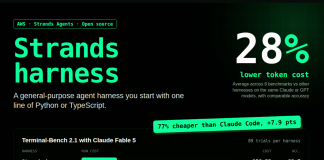
AWS Strands Agents Team Releases Strands Harness: An Open-Source Agent Harness...
Many developers find that an agent idea works inside Claude Code or Codex, then struggles once they rebuild it with their own loop. The...
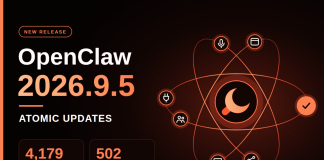
OpenClaw Releases 2026.9.5 With Atomic Updates, Plugin Hot Reload, Conversation Sharing,...
OpenClaw 2026.9.5 ships 4,179 pull requests from 502 contributing accounts. The headline change is Atomic Updates, which check the next version against a private copy of your setup while the current Gateway keeps running. The release also adds plugin hot reload, read-only conversation sharing, GPT Live in meetings and calls, shared browser pages, archiving, and guided specialist-agent setup.

Best Open-Source Agent Harnesses for Local LLMs in 2026
Which open-source harness works with Ollama, LM Studio, or llama.cpp? 11 verified picks with licenses and setup rules.
Agent-net Open Sources Webagent: A Go Harness That Turns Any Website...
Agent-net, the team building an agent-to-agent marketplace where AI agents discover, trust, and pay each other, has released Webagent, an open source harness for...
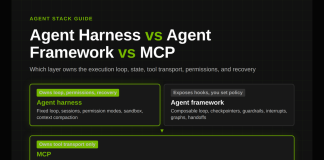
Agent Harness vs Agent Framework vs MCP: Which Layer Owns the...
A practitioner's map of the 3 layers in a modern agent stack, with verified sources and an overlap analysis.
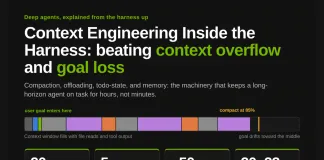
Context Engineering Inside the Harness: 4 Mechanisms That Beat Context Overflow...
A shallow agent is an LLM calling tools in a loop, and on long tasks it fails in 2 ways: context overflow and goal loss. This article opens the harness layer that fixes both, with the actual thresholds shipped by LangChain Deep Agents, Claude Code, Manus, OpenAI Codex and Amazon Bedrock AgentCore, plus an interactive simulator that shows a 200K window filling up.
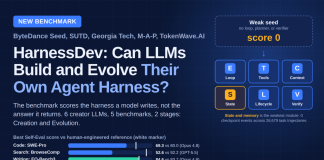
Can LLMs Engineer Their Own Agent Harness? ByteDance Seed’s HarnessDev Says...
ByteDance Seed, SUTD, Georgia Tech, M-A-P, and TokenWave.AI introduce HarnessDev, a benchmark that scores the runnable harness a model builds rather than the answer it returns. Starting from a seed that scores 0, 6 creator LLMs construct harnesses across 5 benchmarks and 2,207 tasks, then evolve them from execution feedback. Self-built harnesses match human references on writing and ML experimentation but trail on code and search, and only 34 of 64 evolution changes move the same direction on held-out tasks.

Google AI Introduces EnvHarness: A Programmable Layer That Turns Static Agent...
Google Cloud AI Research, with Washington University in St. Louis and UNC Chapel Hill, has released EnvHarness, an Apache-2.0 layer that turns a static agent benchmark into one that adapts to the policy training on it. It wraps a frozen environment through the standard reset()/step() interface, so tasks and human-built verifiers stay untouched — and an LLM designer, EnvRigger, writes those wrappers automatically against flaws diagnosed in the agent's own rollouts. Across five benchmarks, mined skills gain up to 9.0 points on held-out tasks with 9.8% fewer execution steps.